


Bone Broth for Joint Pain and Arthritis Relief — India's Natural Guide
There is a smell most of us carry somewhere in our earliest memories — the low, rich, almost savoury warmth that crept from the kitchen and filled the whole house before anyone was properly awake. Bones and whole spices, simmering since before dawn. You did not have to be told it was good for you. Your body already knew.
Your naani knew it too. She never counted milligrams or read a clinical trial. But she knew which foods built people back up. She knew that paya was for the elderly uncle with swollen knees, that a bowl of mutton shorba was what you brought to someone recovering from a fracture, that bone broth — under a dozen different Indian names — was what you fed a body that needed to repair itself. She was not being sentimental. She was being precise.
We stopped being that precise. And our joints are paying for it.
Why Joint Pain Is Getting Worse in India — And What We've Forgotten
More than 180 million Indians live with some form of arthritis or chronic joint pain — a number larger than the population of most countries on earth. That alone is staggering. What makes it more so is who is in that number: urban professionals in their mid-thirties noticing stiff knees after eight hours at a desk. Runners in their forties being told to rest joints that should have years left in them. Mothers who spend the whole day on their feet, ending each evening with a hot water bottle pressed to a knee or hip that simply did not hurt this way five years ago.
Joint pain has stopped being a dignified ailment of old age. It has become the low-grade background noise of modern Indian life.
Understanding why means understanding cartilage — the dense, rubbery cushioning that sits between your bones. Cartilage has no blood supply of its own. It is fed entirely by the fluid around it, which is why it is so slow to repair and so vulnerable to long-term neglect. When cartilage degrades — through daily mechanical stress, through chronic inflammation, through the body simply not having enough raw materials to rebuild at the same pace it breaks down — bones begin to make contact with each other. That is where the grinding, the stiffness, and the pain come from.
Several factors make Indians particularly vulnerable to this cycle. Vitamin D deficiency is widespread in a country that, paradoxically, has sun all year round — most urban Indians spend their days almost entirely indoors. Dietary calcium is low in a large portion of the population. And the heat and humidity that characterise much of India's climate worsen systemic inflammation, which amplifies pain in already-sensitised joints.
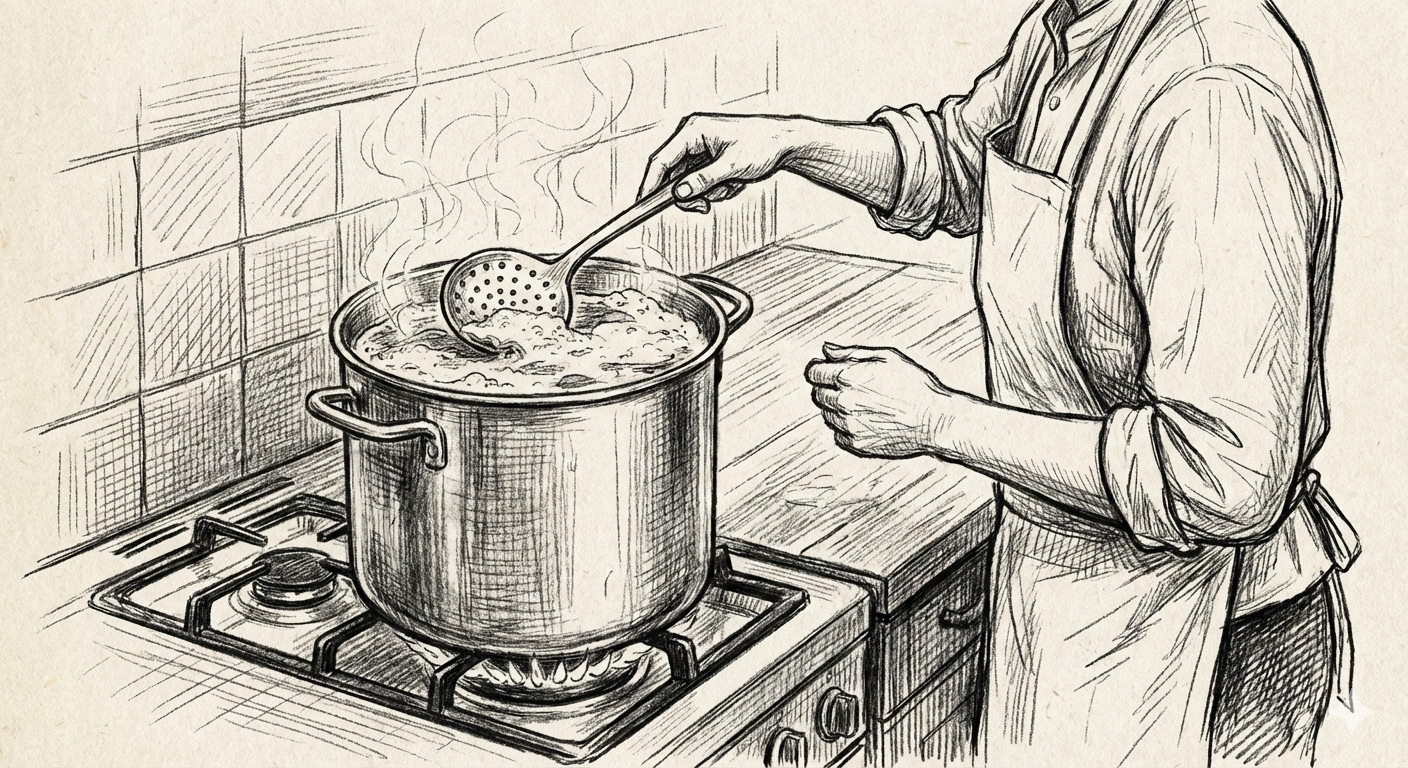
But beneath all of that sits something subtler: a generational shift away from traditional cooking. For centuries, Indian kitchens slow-simmered whole bones for hours — paya, nihari, mutton shorba, yakhni, nalli. These were not dishes made for taste alone. They were functional medicine, even if no one used that phrase. The long simmering extracted from inside the bones something that no pressure cooker, no stock cube, and no quick-cook method could: collagen, gelatin, glucosamine, chondroitin, glycine — the precise compounds that cartilage and connective tissue need to repair and rebuild themselves.
We got busier. We switched to pressure cookers, then to ready-made stock, then to cooking less at home altogether. And we lost something in that transition — not just a flavour, but a form of nourishment our bodies had come to depend on.
The return to bone broth is not a wellness trend. It is a quiet, honest acknowledgement of what we discarded.
What Bone Broth Does for Your Joints — The Science, Plainly Explained
The most remarkable thing about bone broth is how straightforwardly it maps onto what joints actually need. This is not nutritional theory reaching for a connection. The connection is direct.

1. Collagen: The Scaffolding Your Joints Are Built From
Go into any pharmacy in India and you will find glucosamine and chondroitin sold in expensive capsule combinations, often branded as "joint support" supplements. What most people do not know is that both compounds occur naturally in bone broth — released directly from the cartilage and connective tissue during the slow cooking process, at no additional cost, in no capsule required.
When you slow-simmer bones for twelve hours or more, the collagen in and around those bones — in the connective tissue, the periosteum, the marrow channels — breaks down into gelatin and precisely those amino acids. They arrive in the form of whole food, which means your gut processes them gently and your body distributes them to wherever the repair work is most needed.
A clinical study published in Current Medical Research and Opinion found that collagen hydrolysate supplementation significantly reduced joint pain in active adults. The mechanism is the same as bone broth — but collagen hydrolysate is an isolated extract, while bone broth delivers those compounds alongside the minerals, glucosamine, and glycine that support their function. The whole is more than the sum of its parts.
2. Glucosamine and Chondroitin: The Joint Cushions You Can Cook
Go into any pharmacy in India and you will find glucosamine and chondroitin sold in expensive capsule combinations, often branded as "joint support" supplements. What most people do not know is that both compounds occur naturally in bone broth — released directly from the cartilage and connective tissue during the slow cooking process, at no additional cost, in no capsule required.
Glucosamine supports the production of the substances that form cartilage and synovial fluid — the liquid that lubricates your joints with every step. Chondroitin helps cartilage retain water, which keeps it plump and flexible rather than brittle and prone to cracking. Multiple studies have found that together, they can slow cartilage degradation and measurably reduce pain scores in osteoarthritis patients. Bone broth delivers both — not in isolation, but woven through a matrix of complementary nutrients that help them work.
3. Glycine: The Quiet Anti-Inflammatory in Every Cup
Glycine is the amino acid that bone broth is richest in, and it is the one that gets the least attention. Beyond building collagen, glycine has demonstrated direct anti-inflammatory properties in multiple studies — it modulates the inflammatory immune cells that drive joint swelling, and reduces the production of the cytokines that make arthritis flare-ups so debilitating.
For a country where tens of millions deal with inflammatory joint conditions, this is not a minor benefit. A daily source of glycine — in the form of a warm cup you actually want to drink — is a meaningful addition to the body's anti-inflammatory toolkit.
4. Minerals: What Bones Give Back to Bones
During a long simmer, calcium, magnesium, and phosphorus leach from inside the bones into the broth — particularly when a small amount of something acidic (tamarind, lemon, a splash of apple cider vinegar) is added to the cooking liquid. These minerals are not just for bone density. They are essential for the muscles and tendons that support your joints. A knee with strong surrounding musculature bears load far more efficiently than one where the muscles have been depleted. Bone broth feeds the whole system, not just the joint in isolation.
Bone Broth and Arthritis: What Indian Tradition Already Knew

Long before glucosamine appeared in any pharmacist's catalogue, Indian grandmothers were prescribing paya soup — and they were prescribing it very specifically to the right people at the right moments.
If you grew up in a North Indian, Hyderabadi, or Lucknowi household, you likely know paya — slow-cooked goat or lamb trotters, simmered for hours with whole spices until the collagen in the trotters gave up and dissolved into the broth, leaving it trembling and gelatinous and deeply, deeply fortifying. It was the dish made for the uncle whose knees had begun to creak. The dish brought to someone recovering from a broken bone. The dish that appeared on the table whenever a body needed to be built back up. Nobody called it functional medicine. They simply knew, through generations of careful observation, that it worked.
Ayurveda — India's classical system of medicine, which had been thinking systematically about body, food, and healing for millennia before the word "collagen" was coined — describes bone and marrow soups as therapeutic preparations for imbalances in Asthi Dhatu (bone tissue) and Majja Dhatu (marrow tissue). More practically: Vata dosha, which governs movement and is associated with the dryness, cracking, and stiffness that characterise joint pain, is traditionally pacified with foods that are warm, unctuous, and deeply nourishing. A slow-simmered bone broth — warming, rich with dissolved fats and minerals, grounding in the most literal sense — is precisely what that prescription describes.
This is the extraordinary thing about bone broth for joints: it is not ancient wisdom at odds with modern science. It is ancient wisdom anticipating modern science. The intuition was correct all along. We simply now have the molecular language to explain why.
How to Use Bone Broth Specifically for Joint Pain
The most important thing to understand about bone broth for joint health is that consistency is everything. This is not medicine that works in a single dose. Cartilage is dense, avascular tissue — it repairs slowly, supplied by the fluid around it, molecule by molecule. You need to give it sustained nutritional support over weeks, not days, before you feel the difference.

1. Build the Daily Ritual — Timing Matters More Than You Think
Morning, on an empty stomach. Your gut is most receptive, amino acid absorption is at its highest, and you start the day with glycine and collagen precursors already moving into your bloodstream before the inflammatory demands of the day begin. This is the timing most supported by the evidence for joint-specific benefit.
Post-exercise or movement. When your joints have been loaded and are at their most inflamed, a cup of broth in the hour after activity delivers amino acids at exactly the moment tissue repair is most active. If you run, do yoga, or walk for fitness, this timing is particularly valuable.
Evening, as a winding-down ritual. Glycine has documented calming properties — it reduces core body temperature slightly and supports the transition into sleep. And sleep is when most of your cartilage repair actually happens. An evening cup of warm broth is both a nervous-system signal to slow down and a delivery of the compounds your sleeping body will use to do its repair work.
Aim for daily use over four to eight weeks before you expect to notice significant change. Most people report reduced morning stiffness first. Pain reduction tends to follow.
2. Add Haldi, Ginger, and Black Pepper — This Is Not Optional
Indian culinary wisdom and modern nutritional science arrive at the same place here, and it is satisfying every time. Curcumin — the active compound in turmeric — is one of the most rigorously studied natural anti-inflammatories in the world. Piperine in black pepper dramatically increases curcumin's bioavailability. Fresh ginger contains gingerols and shogaols with their own documented anti-inflammatory effects.
Add a pinch of haldi, a crack of black pepper, and a thin slice of fresh ginger to a cup of warm bone broth and you have created a multi-pathway anti-inflammatory preparation that costs almost nothing, takes thirty seconds to assemble, and tastes like something your grandmother would have approved of. This combination is not a recipe. It is a daily act of joint care.
3. Let It Do the Work in Your Cooking — Invisible Nourishment, Every Meal
You do not have to change your diet significantly. Bone broth used as a cooking base — instead of water for dal, rice, khichdi, shorba, or rasam — integrates its joint-supporting nutrients silently into meals you were already going to eat. The taste improves. The nutrition transforms. Your routine stays intact.
The Kettle Tonic Range — Which Broth Is Right for Your Joints?
Every Kettle Tonic broth is slow-simmered the traditional way — real bones, long hours, no concentrates, no artificial flavours, no shortcuts that strip the collagen and mineral content that actually makes a difference. Here is how each variant maps to where you are right now.
Mutton Bone Broth — The Heavyweight for Active Joint Repair
Mutton bones — particularly the large, marrow-dense leg and knuckle bones — carry significantly more connective tissue and cartilage than poultry bones. Kettle Tonic's Mutton Bone Broth extracts from those bones a higher concentration of gelatin, glucosamine, chondroitin, and collagen-forming amino acids than lighter broths can deliver. The resulting broth is rich, dark amber, with a full body and depth of flavour that will immediately recall traditional shorba or the best paya you've ever had.
If you are dealing with moderate to severe joint pain, recovering from a joint injury or surgery, or over fifty and looking to slow the cartilage degradation that accelerates in that decade — this is the most targeted choice. Drink it warm in the evening, or use it as the base for khichdi on the days when your body is asking to be fed carefully.
https://kettletonic.com/products/mutton-bone-broth
Golden Tonic — The Everyday Companion for Proactive Joint Health
A blend of chicken and mutton bones, slow-simmered to yield a broth that sits beautifully between the two: collagen-rich and therapeutically meaningful, but lighter in body and more versatile in the kitchen. The flavour is warm and rounded — rich enough to be satisfying on its own, balanced enough to disappear gracefully into whatever you are cooking.
The Golden Tonic is for someone in their thirties or forties who reads about cartilage degradation and thinks: I want to address this now, before it becomes a problem. It is the most flexible daily habit — as good in a cup on a morning walk as it is stirred into a pot of dal. This is the broth that asks almost nothing of you while quietly doing a great deal for your joints.
https://kettletonic.com/products/golden-tonic
Chicken Bone Broth — The Light Daily Ritual
Lighter in body, milder in flavour, and the gentlest entry point into the bone broth habit. Kettle Tonic's Chicken Bone Broth is a meaningful daily source of glycine and collagen amino acids, and the easiest to integrate into cooking without shifting the taste of your dishes even slightly.
For anyone just beginning, for those with mild stiffness rather than active pain, or for people who find richer broths too heavy — this is where to start. One cup a day, every day, for eight weeks. It is less dramatic than it sounds, and more effective than you might expect.
https://kettletonic.com/products/chicken-bone-broth
Indian Kitchen Recipes for Joint Health — Nourish What You've Already Got

1. Haldi-Ginger Bone Broth Tonic — Your Daily Joint Ritual
The simplest, most effective daily habit for anyone with joint concerns. Five minutes. One cup. Everything your joints need to start the day.
Ingredients:
- 1 cup Kettle Tonic Mutton Bone Broth or Golden Tonic
- ½ tsp turmeric powder
- A thumb-sized piece of fresh ginger, grated or thinly sliced
- A pinch of black pepper (essential — this is what makes the turmeric work)
- A small squeeze of fresh lemon
- Optional: a pinch of cinnamon for depth and warmth
Method: Warm the broth gently over low heat. Do not boil — gentle heat preserves the aromatics and keeps the broth from turning bitter. Add ginger, turmeric, black pepper, and lemon. Stir, pour into a mug, and sit somewhere quiet for five minutes before the day begins. That is not optional. The ritual is half the medicine.
2. Paya-Style Bone Broth Shorba — Dadi's Remedy, Reimagined
Which broth: Mutton Bone Broth
Traditional paya shorba is one of India's oldest joint-restoration preparations. This version captures all of that healing intent in a fraction of the cooking time, using Kettle Tonic's slow-simmered base so the work is already done.
Ingredients:
- 2 cups Kettle Tonic Mutton Bone Broth
- 1 medium onion, finely sliced
- 2 cloves garlic, minced
- 1-inch ginger, julienned
- 1 tsp cumin, 1 tsp coriander powder
- ½ tsp turmeric
- Whole spices: 2 cloves, a small piece of cinnamon, 2 green cardamom pods
- Salt to taste
- Fresh coriander and lime to finish
Method: In a small pot, heat a teaspoon of ghee and bloom the whole spices for thirty seconds until fragrant — the smell alone is therapeutic. Add onion and cook slowly until deeply golden. Add garlic and ginger, cook for a minute. Add the ground spices and stir. Pour in the broth, bring to a gentle simmer for five minutes. Taste for salt. Finish with a squeeze of lime and a handful of fresh coriander. Serve as a restorative cup on cold evenings, rest days, or the days when the joints make themselves known.
3. Anti-Inflammatory Khichdi with Bone Broth — The Healing Bowl
Which broth: Golden Tonic or Mutton Bone Broth
Khichdi is Ayurveda's foundational healing food — easy on the gut, grounding for Vata dosha, deeply comforting in the way that only simple things are. Made with water, it is already good. Made with bone broth, it becomes something close to the most complete joint-nourishing meal you can prepare in under thirty minutes.
Method: Use bone broth in place of water to cook rice and washed moong dal together in a 1:2 ratio until soft and giving. While it cooks, prepare a generous tadka of pure ghee, cumin seeds, a pinch of asafoetida, fresh ginger, and a quarter teaspoon of turmeric. Pour the tadka over the khichdi and finish with a crack of black pepper and one more small knob of ghee on top. The fat helps with absorption of the fat-soluble anti-inflammatory compounds. The simplicity is the point.
Eat this on difficult joint-pain days, post-workout, or any time your body is asking for something careful.
4. Bone Broth Rasam — South India's Answer to Joint Inflammation
Which broth: Chicken Bone Broth for lightness; Mutton Bone Broth for depth
Traditional rasam already contains three of Ayurveda's most significant anti-inflammatory ingredients — black pepper, turmeric, and tamarind. Replacing the water in your rasam recipe with Kettle Tonic bone broth adds collagen amino acids and glucosamine to an already powerful preparation. South Indian wisdom meeting bone broth nutrition — and the result is genuinely remarkable, the kind of dish where you understand, mid-bowl, exactly why this cuisine developed the way it did.
Serve over rice or drink as a warm broth. It is particularly important during monsoon and winter, when joint pain tends to worsen with cold, damp air — exactly the seasons Ayurveda associates with Vata aggravation.
The Kettle Tonic Story — Why This Matters to Us
Kettle Tonic started with a frustration that anyone who has stood in a pharmacy aisle will recognise.
On one side: shelves of glucosamine capsules, collagen powders, joint-support supplements — expensive, synthetic, most of them attempting to replicate in a laboratory what slow-simmered bones do naturally. On the other side: an Indian kitchen tradition, thousands of years old, that already understood what joints need and provided it in a form that tasted extraordinary. The question that kept presenting itself was: why are we recreating, in a factory, what Indian grandmothers made every week without a second thought?
The answer is convenience. Modern life does not leave room for twenty-hour plus simmers. And so we do that work — the slow, careful, uncompromising work — so you do not have to.
Every batch of Kettle Tonic is made the way it has always been made: long hours, quality bones, no concentrates, no flavour enhancers, no shortcuts that would undermine the collagen yield and mineral content that are the whole point. The nourishment your joints need, in a form that tastes like something your grandmother would recognise — because it is made the way she made it.
Explore the full Kettle Tonic range @ https://kettletonic.com/collections/all and find the broth that is right for you.
Frequently Asked Questions About Bone Broth for Joint Pain
1.Is bone broth scientifically proven to help with joint pain?
The evidence is promising — with important context. Multiple clinical studies have found that collagen hydrolysate reduces joint pain in active adults and those with osteoarthritis. Glucosamine and chondroitin, both naturally present in slow-simmered bone broth, have an extensive evidence base for slowing cartilage degradation. Bone broth is not a pharmaceutical intervention, but it is a well-studied, whole-food delivery mechanism for compounds that joints demonstrably need. The science is solid. The outcomes are gradual and cumulative, not acute.
2. How long before I notice results?
Most people who drink bone broth daily report reduced morning stiffness within four to six weeks. More significant pain reduction tends to follow at eight to twelve weeks of consistent use. Cartilage does not regenerate quickly — it is structurally dense and metabolically slow. One cup every day for three months will do more than three cups a day for two weeks. Consistency is the only variable that matters.
3.Which bone broth is best for arthritis — chicken or mutton?
For active joint pain and arthritis specifically, Kettle Tonic's Mutton Bone Broth delivers the most concentrated joint support — larger bones, more connective tissue, more collagen, more glucosamine and chondroitin. The Golden Tonic is the ideal daily option for prevention and maintenance. Chicken Bone Broth is the lightest entry point and provides meaningful collagen amino acids for those who want to build the habit gently.
4. Can bone broth replace my glucosamine supplement?
Many people find that consistent bone broth consumption allows them to reduce or discontinue standalone glucosamine supplements — and they prefer the whole-food form. If you are on a prescribed supplement regimen for a diagnosed condition, speak with your doctor before making changes. Bone broth integrates most effectively as part of a larger approach: good nutrition, regular gentle movement, and supplementation where clinically needed.
5. Is bone broth safe for people with uric acid or gout concerns?
Purines in bone broth can be a concern for people with gout, as purines metabolise into uric acid. If you have a gout diagnosis or elevated uric acid, consult your doctor before adding bone broth regularly to your diet. Chicken Bone Broth generally contains lower purine levels than red meat broths and is typically better tolerated.
6. Can I give bone broth to elderly parents with severe arthritis?
Yes — bone broth is one of the gentlest, most bioavailable ways to deliver joint-supporting nutrition to older people who may find supplements difficult to swallow or who are eating less overall. It is easy to digest, deeply nourishing, and can be incorporated into soft, comforting foods. Many families find that a warm cup of Mutton Bone Broth or Golden Tonic becomes a welcome evening ritual for elders managing daily arthritis pain — not because they were told to drink it, but because it simply feels good to them.

Your Joints Deserve More Than a Painkiller Cycle
Joint pain in India is managed, mostly. Painkillers when the flare-up comes. A glucosamine capsule added hopefully to the morning routine. Rest when movement becomes impossible. It handles the crisis. It does not feed the tissue.
What bone broth asks of you is different. It asks you to be a little ahead of the problem — to give your cartilage the building blocks it needs before the breakdown has outpaced your body's ability to recover. To treat your joint health the way your grandmother treated everything she valued: with consistency, with warmth, with something slow-made and honest that your body actually recognises as food.
One cup a day. A pinch of haldi, a crack of black pepper, a thin slice of ginger. A cooking base that silently transforms the dal and khichdi you were going to make anyway.
That is not a lifestyle overhaul. That is one small, ancient, genuinely pleasurable decision — repeated until the morning stiffness that has become normal starts to feel less so. Until your knees stop making that sound on the stairs. Until your body remembers what it felt like to move without that familiar hesitation.
Your joints built you through decades of motion. It is time to start building them back.
Start your bone broth ritual today to explore Kettle Tonic's Mutton Bone Broth, Chicken Bone Broth, and Golden Tonic — all slow-simmered, preservative-free, and ready to become the most nourishing habit you have ever started.
Published by the Kettle Tonic Team | www.kettletonic.com